Cloud Repatriation: AWS migration to on-premises Intel
r6i, m6i, c6i, and x2iedn EC2 instances/app servers repatriating to on-premises Intel Gen 6
Application servers running on AWS r6i, m6i, c6i, and x2iedn typically fall into clear workload patterns:
r6i handles memory-heavy middleware and app services.
m6i supports mixed, general-purpose application tiers.
c6i is used for CPU-driven, often stateless app layers.
x2iedn supports extreme memory and bandwidth needs.
In AWS, these are consumed as abstracted vCPU and memory slices, with performance influenced by shared infrastructure and virtualization layers. When these workloads are repatriated to Intel Gen 6 on-prem platforms, the model changes: instead of buying slices of infrastructure, you design around real cores, memory channels, and physical topology.
Rather than mapping one cloud instance to one server, workloads are pooled onto fewer, more powerful Intel Gen 6 systems. Memory-heavy workloads are placed on dense-memory nodes, compute-heavy tiers on higher-frequency core designs, and extreme workloads on large-socket platforms. This lets infrastructure be shaped around how applications actually behave, not around fixed cloud instance templates.
Performance, Architecture, and Operations After Repatriation
On Intel Gen 6 hardware, performance becomes more deterministic. Applications are no longer affected by noisy neighbors or unpredictable network paths. Latency between tiers—especially app and storage—becomes easier to control, and tuning options like CPU pinning, NUMA alignment, huge pages, and BIOS profiles are available.
Architecturally, most environments make a few common shifts:
Cloud load balancers are replaced with on-prem or software-defined equivalents.
Auto-scaling gives way to planned capacity with headroom.
DR and backup strategies are redesigned around physical locations.
Operationally, responsibility shifts back in-house. Capacity planning, patching, hardware lifecycle, and performance tuning all become internal tasks. But this also brings more control: maintenance windows are yours, performance issues are more transparent, and infrastructure can be tightly aligned to application behavior instead of cloud abstractions.
Why Repatriation Often Wins
When r6i, m6i, c6i, and x2iedn application servers are repatriated to Intel Gen 6 on-prem, the benefits are not just technical—they are structural.
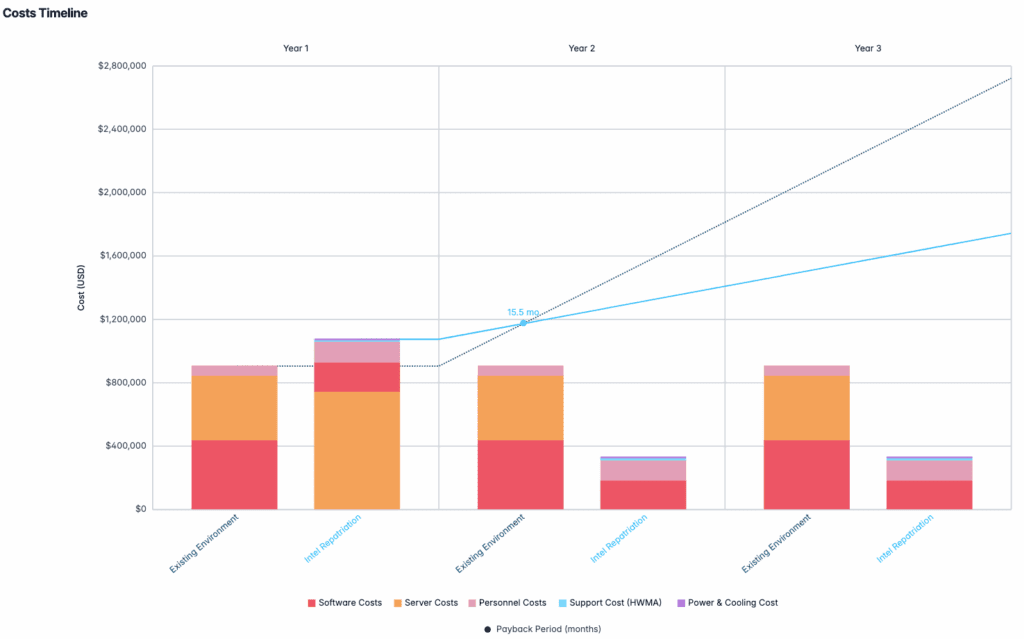
By consolidating workloads onto fewer, more powerful systems, organizations reduce how much raw compute capacity they need to support the same applications. That directly lowers ongoing compute consumption compared to continuously paying for cloud instance hours.
Just as important, many enterprise software products—application servers, middleware, databases, and operating systems—are licensed per core, per CPU, or per VM. When workloads are consolidated and better utilized on Intel Gen 6 hardware, the total number of licensed cores or instances often drops. That means per-license software costs can be reduced alongside compute.
The combined effect is that repatriation of these application servers doesn’t just change where they run—it changes how efficiently they run. Fewer physical systems, higher utilization, and lower licensed footprint typically translate into lower compute costs and reduced software licensing costs, creating a compounding savings effect over time.
Download Full Repatriation Analysis by Filling Out Below Form