VMware Cloud Foundation (VCF) Migration Options Part 2: OpenShift Virtualization Engine (OVE)
As organizations reassess their virtualization strategy, many are looking beyond VMware Cloud Foundation and asking whether virtualization still needs to live on a dedicated, VM-first platform. The Broadcom acquisition of VMware and the resulting shift in licensing models has accelerated this reevaluation. Changes around subscription-only licensing and pricing tied more closely to infrastructure scale have forced many teams to take a harder look at long-term costs and vendor dependence. For organizations that have already embraced containers, OpenShift Virtualization Engine is increasingly seen as a logical next step rather than a lateral replacement.
Why OpenShift Virtualization Engine (OVE) Can Deliver a Better TCO
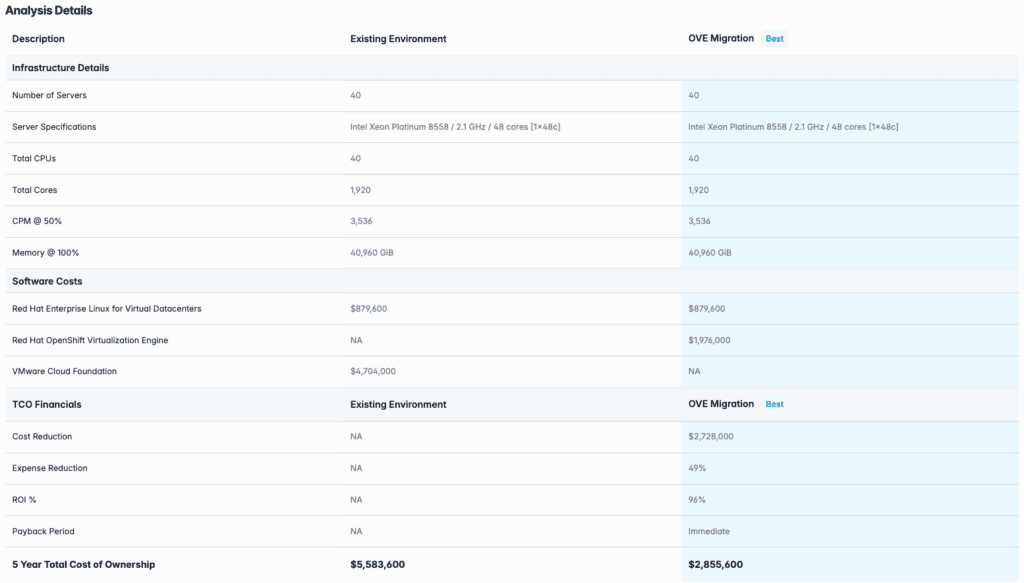
A major driver behind this shift is how total cost of ownership behaves over time. With VMware Cloud Foundation, platform licensing now scales directly with infrastructure density, meaning newer, higher-core servers can materially increase software cost even if workloads remain flat. In contrast, OpenShift Virtualization Engine can reduce overall platform cost for organizations that are already running OpenShift by eliminating the need for a separate, VM-only stack.
Instead of operating two platforms side by side—one for containers and one for virtual machines—virtualization becomes an extension of an existing container platform. That consolidation reduces duplicated spend across management tools, security models, automation pipelines, and operational teams. Over a multi-year horizon, this typically leads to a lower and more predictable TCO, while also creating a clearer path to modernize VM workloads into containers when appropriate.
Why VMware Cloud Foundation Still Has a Role
Despite these pressures, VMware Cloud Foundation continues to be a strong choice in environments where virtualization remains central. It offers a very mature feature set for complex, VM-heavy workloads, deep ecosystem integration, and long-standing operational models that many enterprises trust. For organizations that are deeply invested in VMware skills, tooling, and processes—and where containers are not yet strategic—the higher cost can still be justified by stability and familiarity.
The broader takeaway is that the Broadcom acquisition and the licensing changes that followed have pushed many organizations to actively evaluate alternatives rather than automatically renewing VMware. For container-first environments, OpenShift Virtualization Engine often represents a natural and financially attractive step forward. The full TCO analysis that informed this discussion is available via the link in the comments below.
Download Full VCF Migration Analysis by Filling Out Below Form